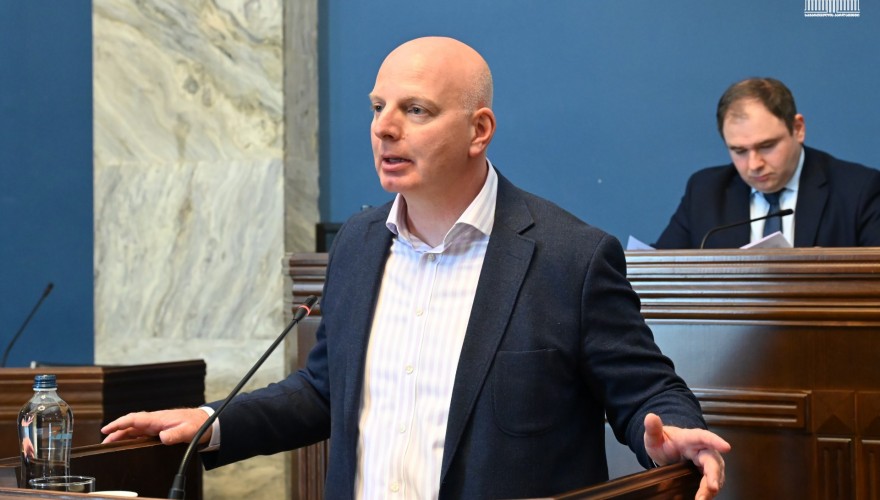
Address of Eka Beselia and Gedevan Popkhadze to the Georgian Society and Diplomatic Corps Accredited in Georgia
The purpose of our address is to once again show the Georgian public and the international community the real face of the United National Movement (UNM), this time manifested in an attempt to use the Constitutional Court of Georgia as a tool of political pressure.
Every government agency and public institution of the country, including the Constitutional Court of Georgia, was politicized by UNM for years. There was no line drawn whatsoever between the public institutions and the ruling party. All government agencies were serving the latter. Said political party pursued the interests of one person and a small group of people related to him.
Today, everyone realizes how the Constitutional Court was formed in the first place. Giorgi Papuashvili, Chairman of the Constitutional Court, was guided in his actions by the interests of the former ruling party, rather than justice. The First Chamber of the Constitutional Court was a particularly strong forefront of the referred party. It was the very unit that issued unconditional rulings on all the key political litigations, as the Chamber was composed of members belonging to the same political team. They were bonded to each other with rather close professional and personal ties.
The idea behind the actions of the Chairman of the Constitutional Court, and some Judges in his close circle, were in full harmony with the signature performance of UNM. It is now obvious that the last resort of the referred political power for creating chaos and “artificial political crisis” is this very group of the Constitutional Court. Frustrated with the failure of the “constitutional revolution” scenario, they still try to revisit the implementation of the mandated political agenda.
As soon as several Judges of the Constitutional Court managed to set themselves free of the political pressure—because they understood that the country could have potentially detoured from the steady path of development if destructive actions were pursued and did not let the former ruling party team manipulate their actions—UNM propaganda immediately targeted them.
In particular, a possible collapse of the election process was averted two weeks ago because it was not supported by the majority of the Constitutional Court Judges. If the appealed election provisions had been voided, the feasibility of conducting the October Parliamentary Elections could have been questionable given the short period remaining before due date.
It was actually after this that the Chairman of the Constitutional Court made open, politicized and clearly provocative statements about Judges allegedly being pressured.
None of the referred Judges confirmed that they were put under personal pressure when questioned at the Chief Investigation Authority of the country.
Moreover, five Judges of the Constitutional Court clearly referred to some of the most significant violations of the law that were practiced at the Constitutional Court, namely:
- Tempering with politically sensitive lawsuits in favor of the plaintiffs and their interests;
- So-called “politically pressing” lawsuits were referred only to the so-called “trusted” 1st Chamber and, even there, selectively, only to particular three Judges;
- Certain cases were filtered by political features and ruled in an unprecedentedly short period by violating the principle of case sequencing.
After making all these facts public, these Judges became targets of attacks and accusations from the UNM, its next-to-kin parties and individual satellite NGOs. They now label the Constitutional Court a dismantled body, while the majority of Judges, the five authors of this letter (Constitutional Court is composed of nine members), disgraced and discredited judges.
But what actually turned into the cause of their aggression is the failure to see their plan materialize by sabotaging the Constitutional Court, on one hand, and on the other, the exposure of shadow deals between the Chairman, some of the Constitutional Court Judges and the former ruling party.
More specifically, the following violations were exposed:
1. Most appalling information has been released on the hidden tempering with officially filed lawsuits, i.e. signs of discreet cooperation between one group of Judges and some plaintiffs has been detected. In particular, lawsuits filed with the Constitutional Court were returned to the plaintiff with some suggestions for adjustments presumably after some verification and later got resubmitted with suggested adjustments, alterations in the substance and increased claim. They would ultimately be registered with the same reference number and original lawsuits would thus be substituted. Clearly, it was done to make sure the claim was upheld, i.e. the outcome of the case was practically decided in advance. Hence, court hearings were only a farce. So far, it has been possible to detect two such alleged cases, both of them related to lawsuits with political overtones: the first case is the so-called Cable Case, while the other is one of the two Rustavi 2 lawsuits, currently ruled in favor of the TV Company.
2. It turns out that the Chairman of the Constitutional Court was purposefully assigning some of the filed lawsuits with political features to the same Judges. It was mainly done in the “trusted” First Chamber, though some degree of “selection” was applied there as well. In particular, “for some reason” such cases were systematically referred only to three Judges (K. Vardzeashvili, M. Kopaleishvili, M. Eremadze), while the 4th Judge (M. Turava) would not be assigned, as he was considered “untrustworthy”. Here again, lawsuits with political features were artificially assigned to the abovementioned Judges to make sure that the ultimate Court Ruling matched “the required outcome”. That is, a “personal” Chamber operated at the Constitutional Court for particular claimants, which heard cases in a “special” setting. Not to mention the Second Chamber (it also had four Judges), which was not assigned to such cases. It comes as no surprise because M. Kopaleishvili and K. Vardzelashvili used to hold high government offices during the previous term and prior to being appointed as Judges. They had close professional and private bondage with many UNM high-ranking officials, including N. Gvaramia (current CEO of Rustavi 2 broadcasting company). Specific facts were publicized as well and recusal of Judges was requested on the cases of Rustavi 2. Because of their bias, however, they continued presiding over these cases, ultimately upholding them. It is noteworthy that all eight (!) lawsuits of Rustavi 2 (of which one application was substituted) was referred to these very three Judges of the 1st Chamber. They were also assigned to all three cases involving former Tbilisi Mayor G. Ugulava and the so-called Cable Case (the original lawsuit was substituted here as well). In addition, the following lawsuits were assigned to this group of Judges: Election Lawsuit (whereby G. Papuashvili started to make provocative statements on the day following the date when case was not upheld), Public Broadcaster Case (where the old Board of Supervisors was reconstituted), Banking Supervision Agency Case (whereby it was rendered void), the so-called Double Key Taping System Case (whereby it was rendered void), and others.
3. It was confirmed that lawsuits with political features were segmented and ruled in an unprecedented short timeframe, while other, “regular” cases were put in queue, though they were filed much earlier (years back). Over the past decade, the Plenary Session has not spent less than four months to rule on any case (except for G. Ugulava’s two cases), and in all the other cases the majority of lawsuits were ruled within a period of 7 to 20 months. Given these statistics, contrast is striking. One lawsuit related to the case of Rustavi 2 broadcasting company was essentially ruled by the Plenary Session on the 2nd (!) day from the date of filing, while the second case of the same broadcasting company on the 3rd day after the date of filing. In relation to the other lawsuits of Rustavi 2 broadcaster, provisions of the law were put on hold by the Constitutional Court in a few days after the original filing date without any hearings, i.e. without formally listening to the parties and, accordingly, without allowing them to present their positions on the matter. Such precedent (whereby a provision of the law is put on hold without the parties being present) has never occurred before in the history of the Constitutional Court. These are unprecedented cases in the operation of the Constitutional Court, clearly indicative of bias. Also, the Plenary Session started hearings on the merged lawsuits of G. Ugulava and the so-called Cable Case in almost a month after they were filed, while the previous two lawsuits of G. Ugulava were ruled in about three months. Practically, throughout this period, the Constitutional Court of Georgia clearly operates selectively and rules on cases in the most expedited manner, which is naturally linked to the interests of the UNM. In light of the foregoing, human rights are clearly violated as the sequence of the court case management is abused, and some citizens wait for years to receive Court Rulings on their lawsuits and enjoy their rights.
The letter of the Majority of the Constitutional Court focuses on said issues. It is addressed to the Chairman of the Constitutional Court to put an end to the malpractice of such subjective approaches and to make sure that the Constitutional Court operates in a calm, consistent and unforced manner, with the principle of equality respected for every party involved.
Ultimately, we may conclude that the performance of the Constitutional Court was tailored to suit the political agenda of the UNM. In particular, when despite fierce opposition from this party, the current authorities passed laws in Parliament to capitalize on the institutional reforms and regulate issues related to political principles, Constitutional Court immediately intervene on the grounds of lawsuits filed by UNM MPs or their representatives. Such cases were then assigned to the “trusted” 1st Chamber. It would at first suspend the enforcement of the law in question in an expedited manner, subsequently declare the disputed law void in the same forced manner. Such cases are plenty: voidance of the Law on Public Broadcaster, which reconstituted the authority of the old Board of Supervisors, triggering an artificial crisis within the organization (as the original composition was made up of UNM supporters and thus the political party maintained its influence over the broadcaster); voidance of the Law on Banking Supervision Agency, which did not let the newly established body to operate (preventing it from becoming a body controlling G. Kadagidze, Governor of the National Bank of Georgia appointed by the UNM); voidance of the Law on Discreet Investigation Efforts, which led to the annulment of the newly established system, which clearly had a higher performance standard and double key control mechanism (so as maximally to diminish the effectiveness of the law enforcement bodies, while under the previous authorities there was practically no standard in this area and taping applied totally to everyone and anyone in the country. With the proposed new model, certain control mechanisms were to be introduced in the form of the Office of the Personal Data Protection Inspector), and others.
UNM and G. Papuashvili, Chairman of the Constitutional Court of Georgia, intended to continue such “tried and approved cooperation” with the same “success”. Had it not been for the amendments made in Parliament to the legislation on the Constitutional Court (which led to the increased authority of the Plenary Session, and others), country would practically be challenged with a threat of an inevitable constitutional sabotage to trigger an artificially planned political crisis (with all its consequences).
We hope that the abovementioned malpractice will be objectively assessed and current occurrences will be analyzed duly, so that such institutional problems no longer face our country, to guarantee that the operations of public and constitutional authorities are aimed to protect human rights, instead of serving one political group or another.
Eka Beselia, MP
Chairman of the Parliamentary Committee for the Protection of Human Rights and Civil Integration
Gedevan Popkhadze, MP
Deputy Chairman of the Parliamentary Committee for the Protection of Human Rights and Civil Integration