Parliament Overcoming President’s Veto on Amendments to the Criminal Procedure Code with 79 Votes
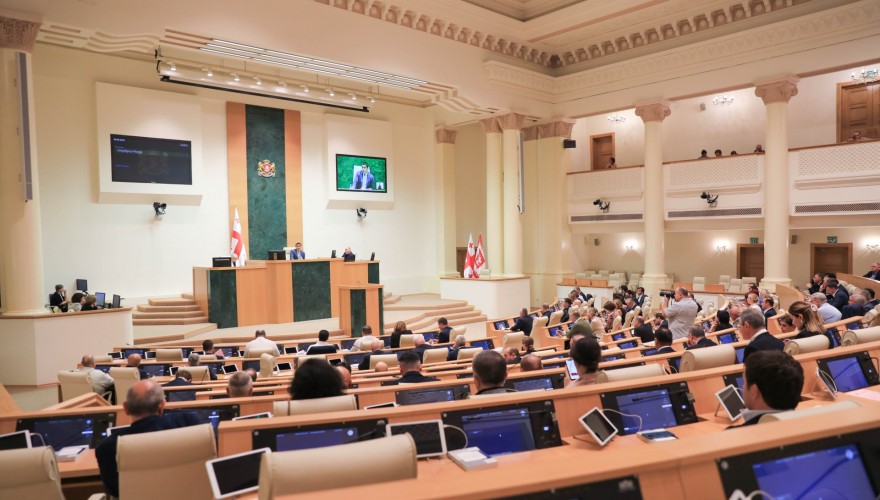
The Parliament overcame the President's veto on Amendments to the Criminal Procedure Code of Georgia with 79 votes.
At today’s Plenary Session, the Parliament discussed the motivated remarks of the President of Georgia on Amendments to the Criminal Procedure Code of Georgia.
According to the parliamentary secretary of the President of Georgia, Giorgi Mskhiladze, the adopted draft law significantly worsens the standard of human rights protection.
“It is unfortunate that the Parliament is going to override the President's veto and finally pass a law that contradicts European standards and worsens the protection of human rights, which threatens to shape our European future, while the Prime Minister is in Brussels for the first time since the announcement of the 12-point recommendations and is conducting negotiations on the country's European integration issues. Both the number of criminal offenses for which it is possible to carry out undercover investigative actions and the deadlines for doing so are growing”, - the rapporteur noted.
According to Anri Okhanashvili, the motivated remarks of the President were not presented either at the committee meeting or at today's plenary session. According to him, in connection with the mentioned issue, there were a number of meetings attended by both civil society and opposition representatives.
"Although these are not just empty words, the President may exercise her veto power. The President is required by law to provide the Parliament with well-reasoned statements. Constitutional law generally agrees that in this instance, sending a document to the parliament also involves making statements with motivated remarks. We have the suspensive veto in this situation, which allows the President to halt the passage of a bill and then send it back to Parliament for further discussion. This is a fundamental constitutional tenet and legislative necessity that the President and her officials have failed to meet", - Anri Okhanashvili remarked.
According to the Chairman of the Human Rights and Civil Integration Committee, Mikheil Sarjveladze, the initiators took into account the comments made during the discussions of the draft law.
"The state at one point thought that in addition to terrorism, covert investigative action should be permitted for offenses such, for instance, offenses involving inciting racial unrest. The only venue for the President to express a contrary opinion is in the Parliament, but she must do it in the form of motivated remarks rather than general "motivated remarks”. More than 20 articles were provided in the initial version on which it should be possible to conduct investigations. We talked about it and decided that applying this to the other 20 articles would not be suitable", - Mikheil Sarjveladze noted.
The Parliament overcame the President's veto with 79 votes.