Foreign Relations Committee Discussed Recommendations Submitted to Georgia Following the Review of the 2025 National Report on the Human Rights Situation in Georgia
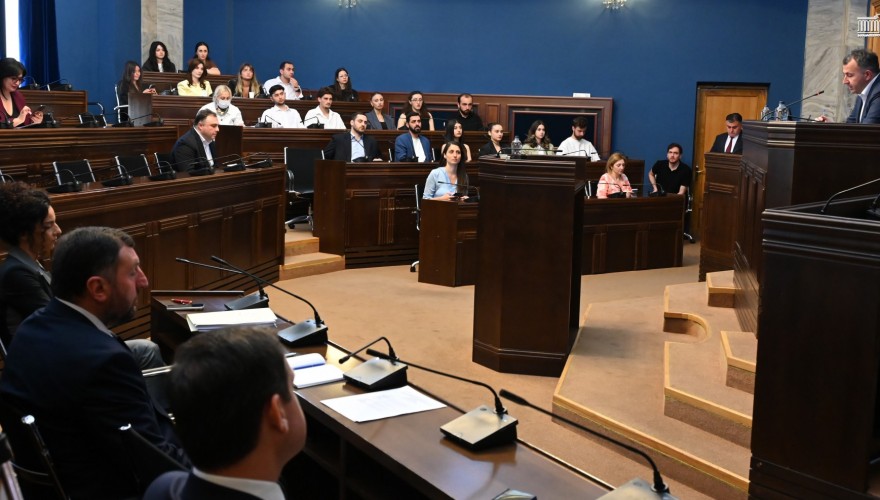
Members of the Foreign Relations Committee were briefed by Deputy Foreign Affairs Minister Khatuna Totladze on the recommendations submitted to Georgia following the review of the country's 2025 National Report on the Human Rights Situation in Georgia within the framework of the 4th cycle of the Universal Periodic Review (UPR) of the UN Human Rights Council.
According to her, during the consideration of Georgia's national report in Geneva—which covered the period from 2021 to 2025—the Georgian delegation presented information on the reforms implemented by the authorities to improve the protection of human rights in the country.
The national report was prepared under the coordination of the Foreign Affairs Ministry with the participation of all relevant state institutions.
During the review of Georgia's report, in which 106 UN member states participated, 307 recommendations were issued to the country.
As the presenter noted, Georgia supported approximately 160 recommendations.
These include recommendations concerning: strengthening the human rights framework; mobilizing international efforts to ensure access for international mechanisms to the occupied territories and enhancing cooperation with the international community to facilitate the safe return of internally displaced persons and refugees; ensuring the effective and coordinated implementation of the National Human Rights Strategy; preventing and combating racism, xenophobia, and hate speech; strengthening the education and training of law enforcement personnel; improving access to healthcare services; and other related issues.
According to Khatuna Totladze, Georgia does not support a number of recommendations, and the reasons for this position are reflected in a detailed explanatory table.
She further noted that, in many cases, the report contains recommendations that Georgia has already fulfilled; therefore, Georgia also does not support those recommendations.
As the Deputy Minister stated, the table of recommendations, together with Georgia's positions and justifications, will be translated into English by the Foreign Affairs Ministry and officially submitted to the UN Human Rights Council.
The adoption of the final report on the review of Georgia's national report is expected during the 62nd session of the UN Human Rights Council, to be held in June–July 2026.
The Committee also discussed documents submitted for ratification.
First Deputy Finance Minister Giorgi Kakauridze presented to committee members Amendment No. 1 to the Framework Credit Facility Agreement between the French Development Agency (AFD), as Lender, and Georgia, as Borrower, dated 15 November 2022, which provides for a nine-month extension of the agreement's validity period.
To finance the Human Capital Development Programme, the French Development Agency allocated EUR 100 million to Georgia.
Under the first tranche, Georgia had access to EUR 50 million. At this stage, the French Development Agency is prepared to activate the second tranche in the amount of an additional EUR 50 million.
The Committee also considered the Protocol on Amendments to the Free Trade Agreement between the Government of Georgia and the Government of the People's Republic of China, presented by Deputy Economy and Sustainable Development Minister Genadi Arveladze.
The Protocol was signed on 22 April 2026 and constitutes an update to the agreement originally signed on 13 May 2017.
Its purpose is to clarify certain general provisions of the existing agreement and to introduce new areas of cooperation.
The updated agreement is expected to promote bilateral investment, simplify foreign trade procedures, establish sanitary and phytosanitary measures, strengthen economic opportunities through e-commerce, and support other areas of economic cooperation.