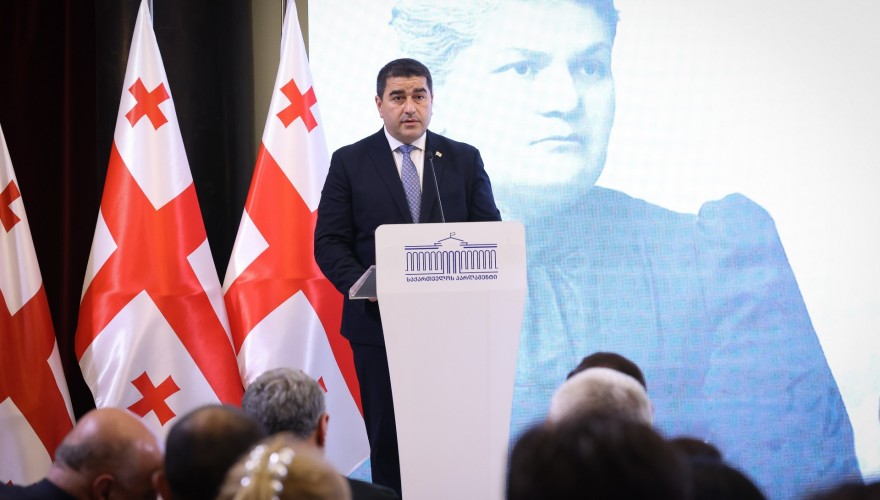
The Speech of the Chairman of the Parliament of Georgia, H.E. Shalva Papuashvili at the Hearing of the Foreign Affairs Committee of the French National Assembly
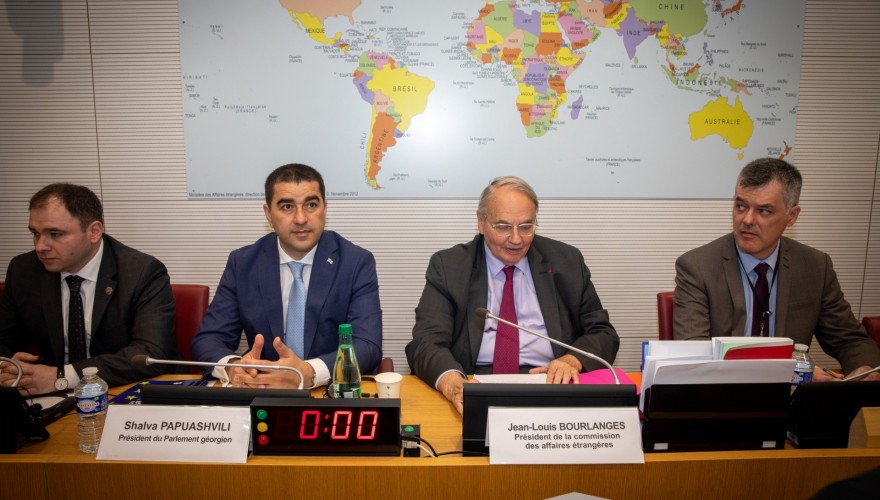
I am honored to be here, at the French National Assembly, the birthplace of modern parliamentarism, and to speak about the rich, dynamic, and multidimensional relationship between Georgia and the French Republic.
First of all, let me recall the principled and generous assistance that your great country rendered to Georgia since the very first days of our independence. Your political support for our freedom and territorial integrity has been crucial, but also very important was the humanitarian, economic, and technical assistance. Let me express our gratitude also for the academic exchange programs that helped our youth, my generation, to study in France so that we were able to conduct the necessary reforms that transformed Georgia into the country, which made an incredible progress in the last three decades and is now vying to become a member of the European Union.
The current cooperation between our countries is based on common European values and support for the rules-based international order. We highly welcome recent positive dynamics in our bilateral relations that confirm the strategic character of Georgian-French partnership, which transcends regional politics and reaches transnational dimensions.
French support for Georgia’s sovereignty and territorial integrity has been instrumental in successfully maintaining the non-recognition policy of Georgia’s occupied regions across the globe, and we are grateful for this unwavering commitment. It bears even greater significance under current challenging security environment in the wider Black Sea region. We also truly appreciate the substantial role France has played in the process of Georgia’s institutional and socioeconomic transformation, as one of the largest international donors over the years.
Recently Foreign Minister Colonna has paid an official visit to Tbilisi. It was a robust signal of political support towards Georgia. As we proceed on our European path, we were particularly encouraged by the statements made by Minister Colonna that reaffirmed France’s readiness to stand by Georgia in its efforts towards becoming an EU candidate country by the end of the year. Indeed, we count on further support of our French friends at this critical juncture of Georgian history.
We live in a world of geopolitical change that causes political, economic, social, military, and environmental turbulences. For Georgia, this painful process manifests itself in the ongoing Russian aggression against Ukraine, resurgence of the military confrontation between Armenia and Azerbaijan, and other potential and smoldering conflicts in Georgia’s neighborhood.
With the Russian invasion of Ukraine, the European security architecture came under tremendous pressure. We understand Ukraine’s pain and suffering. Georgia experienced Russian aggression throughout the early 1990s and, then again, in 2008. This continuous aggression resulted in the occupation of two Georgian regions, Abkhazia and Tskhinvali Region/South Ossetia, and forceful and illegal expelling of hundreds of thousands of people from their towns and villages. Russian occupation and the violation of the local population’s rights continue to this day through illegal so-called borderization, kidnapping of Georgian citizens, and creeping annexation of Georgian territories, which constitute up to a fifth of Georgia’s area.
Unfortunately, at that time, back in the 1990 as well as in 2008, despite our appeals and warnings, we did not receive adequate response from the West. Some European countries, and also the European Union, even to this day, refuse to call Russian actions in Georgia its proper name – occupation. This is happening despite numerous judgements by the European Court of Human Rights, recognizing Russia’s effective control of Georgia’s occupied territories.
Fortunately, however, we now see a strong, united, and effective European response to Russia’s aggressive actions.
We, too, stand with Ukraine. We have demonstrated our solidarity not only in words, but also with strong political and diplomatic steps. Our bold steps are taken against the background of Russia’s illegal military presence only a few miles away from Tbilisi. Georgia faces high risks of possible military escalation. Yet we are not protected by NATO security umbrella. And yet, within our means, we have fully supported Ukraine in its fight for territorial integrity.
Amid challenging geopolitical situation, Georgia firmly maintains its foreign policy priorities:
1. Georgia remains a reliable partner for NATO and the EU in international security matters. We participated in crucial peace-making missions in Afghanistan and, with our French partners, in Mali and the Central African Republic.
2. Our policy towards Russia is based on a responsible approach, which helped to mitigate the threat of direct Russian invasion and which was advocated and supported by France and other strategic partners.
3. Georgia remains an important pillar of stability in the South Caucasus region, among others, having helped to mediate peace between Armenia and Azerbaijan.
4. Georgia continues developing global partnerships for de-occupation of our lands from Russia and international non-recognition of the occupied territories.
5. Georgia is an ally of Europe when it comes to global challenges such as climate change and fight against terrorism.
For decades now, Europeanization has been the engine of Georgia’s internal and foreign policies. Europeanization has also been a driver for Georgia’s democratization agenda.
Georgia now has a European perspective on the EU membership road. There is already no question on Georgia’s European future - something that many generations dreamed about and fought for.
We have been diligent in addressing 12 priorities for gaining the EU candidate country status. We started our work immediately after the European Council decision was published almost exactly a year ago. Through a very intensive, inclusive and transparent domestic process of implementation involving all stakeholders, we have implemented up to 80% of the priorities. We have done so in close cooperation with civil society organizations, our partners in the EU, and most importantly with the Venice Commission and the OSCE/ODIHR. And no matter who assesses the progress and how, the fact is that we have been creating a solid and sustainable foundation for Georgia’s European future.
On April 19, 2023, we handed over to the EU our first-ever contribution/report to the Commission’s Enlargement Package to be published in autumn this year. The document displays the substantial work done over the past year and describes the progress achieved in various fields, including, competition, public procurements, financial services, labor regulations, the rule of law, consumer and health protection, media freedom, social policy and employment, agriculture, education, and other areas.
We expect that Georgia’s performance will be properly assessed and respective decisions taken based on a merit-based approach. It is critical not to differentiate Georgia from other associated trio partners any longer. The analytical report of the European Commission published in January 2023 confirms Georgia’s remarkable progress in legal and institutional convergence with the EU in almost all sectors. It also confirmed Georgia was a leader in the Associated Trio and deserved a candidate status already a year ago. However, we have closed this chapter and as a future-oriented and forward-looking nation, we make our way to the future with diligence, hardwork and hope. As a result, the Georgian people and the government expect that the candidate status will be granted to Georgia this year. We also expect that EU accession negotiations with Georgia will start together with Ukraine and Moldova.
Granting a EU candidate status to Georgia will further energize Georgia’s young but dynamic democracy, and will provide impetus to other countries in the region to embark on the path of democratic transformation.
Georgia is not only recipient of European security and economic benefits, but increasingly also a contributor to the cause of European security, including by essential support to EU’s CSDP missions in Africa. Georgia also contributed the largest per capita military personnel for NATO peace operations in Afghanistan, among others.
Since the beginning of the Russian aggression in Ukraine, diversification of European energy supplies has become an acute problem. Now, Georgia is a critical and essential part of the so-called “Middle Corridor” that might serve as the safest and shortest route for alternative energy supplies to Europe. The Black Sea Submarine Electricity Cable project that creates transit opportunities for green renewable energy between the EU and the South Caucasus is one of the most recent efforts to promote diversification of energy supplies.
We stand ready to continue working with the EU on enhancing connectivity in the Black Sea to open up alternative routes of energy supply, freight transportation, and digital connections that will translate into sustainable economic growth and greater European resilience.
For all these years, Georgia did its best to become member of NATO and get into the EU, despite the real and present danger of Russian reprisal for doing so. Despite becoming fully interoperable with NATO, developing democratic institutions beyond the Alliance’s entry-level standards, and codifying European and Euro-Atlantic integration into its Constitution, Georgia has been left out in the cold ever since NATO committed itself to making Georgia an Alliance member in April 2008, at the NATO Bucharest Summit. It is of utmost importance to have tangible progress in the political dimension of the integration process. We understand that it is difficult to achieve any breakthroughs before the end of the war in Ukraine and the Ukrainian victory, but it is necessary to start discussions on the possible outlines of a new security architecture in Europe.
As a country in transition, Georgia still faces challenges as we strive to build a strong, resilient, democratic society. However, we are confident that with the support of our friends in France and beyond, we can overcome these obstacles and realize our vision for a prosperous and peaceful future.
It is high time for our Western partners to help us to overcome our security predicament and get the well-deserved membership in NATO and the EU. For over 15 years now, the ball is on the Western side, on both EU and NATO courts. President Macron is a notable champion for the European cause. Now, it is the time for the EU to invest in long-term peace by taking the next immediate step to support Georgia’s candidate status this year and start immediate negotiations for the European membership.
Our two nations shared interested periods of common history and culture that has brought us together to this day, and today we stand united in our pursuit of a democratic and European future. May God bless these Georgian-French relations, and may our partnership continue to thrive for generations to come.