
Budget and Finance Committee Hearing State Audit Report of 2019
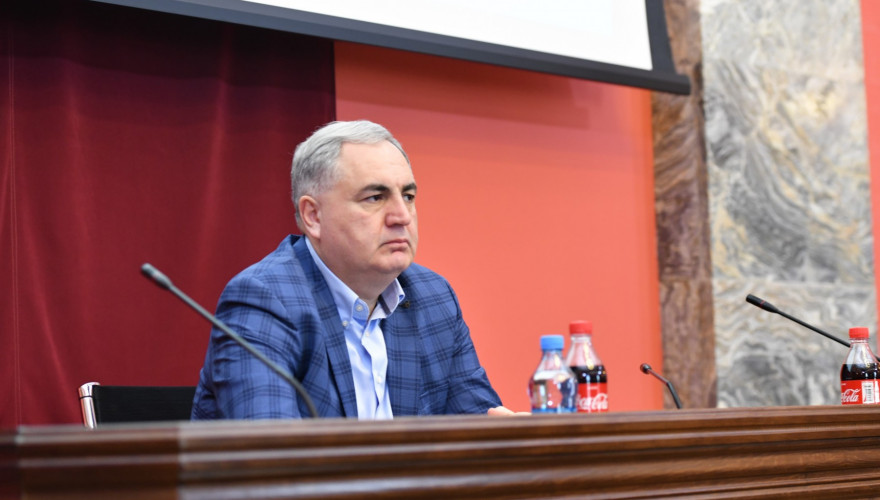
The Budget and Finance Committee heard the State Audit Office Performance Report of 2019 presented by the Auditor General Erekle Mekvabishvili.
The Chair of the Budget and Finance Committee, Irakli Kovzanadze positively estimated the Service’s work and spoke about the existing challenges.
“Compared to the consolidated budget of 2018, the State Audit Office increased its coverage rate of the budget to 87%. This means that they have covered over 12 bl GEL from the consolidated budget and this fact shall be appealed. The basis of the State Audit Office relies upon independence, professionalism, objectivity, good faith, and informing the public, which was supported by the Parliament with this legislative change to the Law on Audit Service and the Rules of Procedure. These are very important postulates led by the Audit Office. With the increasing number of issued recommendations up to 1067 as of 2019, I believe strengthening the Parliamentary Oversight to these recommendations is one of the main challenges”, - Irakli Kovzanadze remarked.
The Chair also drew attention to the high international standard of the performance of the Audit Office – “Instead of approving the Parliamentary Group during the sessions, we now study the activities of the Audit Office in compliance with international standards. As of December 31, 2019, the consolidated financial report was verified by Deloitte & Touche, which concluded that no significant errors were identified with financial accounting and reporting of the Service”.
The Auditor general outlined several important areas in terms of strengthening the independence and mandate of the Audit Service - “First of all, the Law on State Audit Office has received the status of an organic law. Moreover, our activities have been inspected by an independent international auditor for the second year in a row. At this, we maintain positive estimations and full compliance with the international standards”.
Pursuant to the Audit Report, in 2019 the Service managed to accomplish 70 audits, the budget coverage rate reached a historic high of more than 12 bl GEL.
According to the speaker, the main product of the Audit Office is the recommendations issued as a result of the audit and the benefits of their implementation, which is reflected in the improvement of public finance management and the creation of value for citizens.
As E. Mekvabishvili added, over 1000 recommendations were issued in 2019.
The Service has created an electronic system for monitoring the implementation of recommendations, which fully transfers the process of issuing, implementing, and monitoring recommendations in the electronic space and ensures proactive communication with audit facilities, automation of processes, and introduction of an operative monitoring mechanism.
The Report introduced the main results of the Audit activities, state of implementation of the recommendations, the involvement of key partners - the Parliament and the Government, public relations, international cooperation, etc.
After the report, the rapporteur answered the questions of MPs.
The Committee took note of the report, which will be further considered at the Plenary Session.
The Committee discussed the Bills on Tax Code and Customs Code, introduced by the Deputy Finance Minister, Lasha khutsishvili.
The amendments address all the provisions of the VAT regulation provided for by the Tax Code, define the general principles of VAT taxation, and explain the importance of the terms used for the purpose of VAT.
The Committee considered with the II reading the Bill on Investment Funds with accompanying documents, which were introduced by the Deputy Minister of Economy, Ekaterine Mikabadze.
The draft law regulates the issues, related to the establishment and management of the investment funds and assets management companies. The bill stipulates the conditions to regulate the activities of such funds and companies in Georgia.
The Committee also considered the Bill authored by independent MP Eka Beselia on State Customs, exempting pensioners from paying all state fees in all cases heard in common courts. This will make it possible for a person of retirement age to exercise their constitutional right to freely apply to the court for the protection of their rights.
The Committee considered it expedient to exempt pensioners from court fees only in the case of pensions and other social issues and approved the document with this precondition.
Dimitri Tskitishvili introduced the Bill by MPs: Dimitri Tskitishvili, Sophio Kiladze, Davit Matikashvili, Tamar Chugoshvili, Irakli Kobakhidze, Rati Ionatamishvili, and Tamar Khulordava on Changes to the Labor Code with accompanying drafts.
According to him, the draft law normalizes previously unregulated or incompletely regulated labor law issues.
Providing the existing gaps and challenges, the Labor Code shall be approximated to the standards envisaged under the EU directives and ILO conventions. Besides, the bill will fulfill the significant part of the EUAA commitments. It will facilitate the improvement of labor rights protection. Given the provision of harmonization, the bill envisages regulation of prohibition of discrimination; verbal and termed labor agreement; labor agreement conditions; legal status of interns; partial working day; working hours; right of break; overtime; shifts; night labor; pregnancy and maternity; child care leave including the fathers; salaries and minimal salaries; mass dismissal; right of the strike; collective labor mediation; information and consultation, etc.
Representatives of the National Bank, trade unions, business associations, and public organizations took part in the discussion of the issue.
The speaker answered the questions after which he was given written remarks by the Committee regarding the Bill.
Roman Kakulia introduced his legislative initiative concerning the Changes to the Law on Competition with accompanying drafts.
According to him, Bill will serve as a step towards the actual creation of the market economy in the country.
The draft aims to eliminate several practical and legal deficiencies and to improve the law enforcement mechanisms.
The speaker presented the slides and scrutinized the changes envisaged by the draft, noting that "the Bill preconditions a law with solid enforcement mechanisms - which will increase the efficiency of the competition agency and yield a positive impact on the country's market structure, economic agents and a fair competitive environment."
The Committee approved the Bill with specific remarks.
MP Merab Kvaraia introduced the Bill on Social Entrepreneurship along with the accompanying drafts, envisaging the creation of a legal basis for the institutionalization of social entrepreneurship and support for its development.
All other details and social entrepreneurship support strategies will be developed by the Government if the Bill is passed.
According to the rapporteur, the development of social entrepreneurship is an approach that is becoming more and more widespread and settled in developed countries. Social entrepreneurship solves important issues for the public in less interesting areas for ordinary businesses, be it caring for vulnerable groups, protecting the environment, or social services.
Merab Kvaraia also introduced the Bill on Administrative Offenses with accompanying drafts.
The Bill deals with the rules of parking within the administrative borders of the capital. According to Zaza Gabunia, "The Bill regulates sundry issues vital for improved traffic: defines the offenses and introduces relevant penalties, it improves the delivery of a fine receipt and makes the fine enforcement mechanism much more flexible and efficient”.
The Committee also heard the Report by the LEPL Pension Agency for 2019, which was introduced by the Acting Director of the Agency Giorgi Chichinadze.
The report included information on the organizational structure of the Agency, staffing schedule, budget, and staffing, as well as the electronic pension administration system developed by the Agency. The rapporteur spoke on rules of leaving the accumulative pension scheme, pension contributions, return of these contributions, etc. He focused on the vision of risk assessment, development, and improvement of the accumulative pension scheme and the relevant recommendations.
MPs expressed their views and asked questions.
The Committee took note of the report.