
The Secretary General of the Parliament, Kakha Okrojanashvili Presented the Draft 2027 Parliamentary Budget to the Budget and Finance Committee
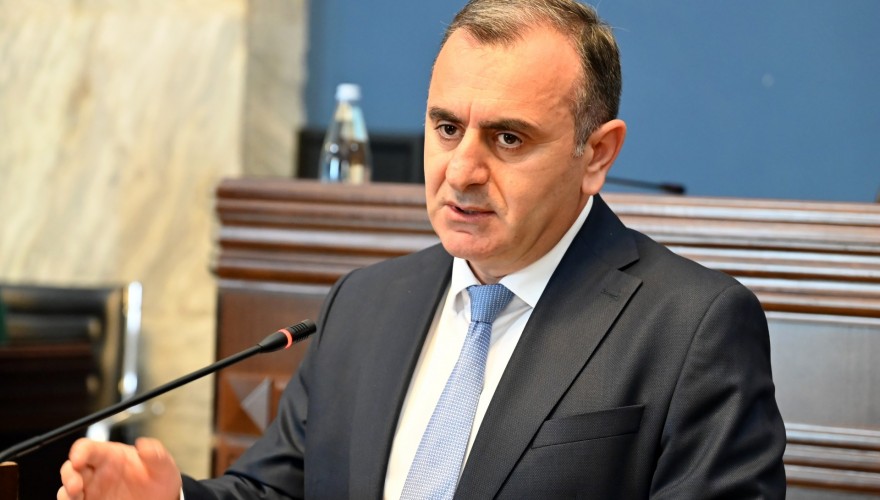
The Budget and Finance Committee discussed the draft budget of the Parliament for 2027, which was presented by the Secretary General of the Parliament, Kakha Okrojanashvili.
According to Kakha Okrojanashvili, within the framework of the country’s Basic Data and Directions document for 2027–2029, the projected total volume of the Parliament’s 2027 budget was initially set at GEL 102 million. However, considering that, at the initiative of the Speaker of Parliament, the salaries of 49 Members of Parliament who did not take up their mandates were removed from the 2026 budget, the Parliament’s budget in the 2027 draft was reduced by GEL 10.46 million, bringing the budget for the coming year to GEL 91.54 million.
According to him, the number of staff positions under the Parliament’s 2027 budget draft remains unchanged at 708 units.
The Secretary General also introduced the committee members to the figures under the economic expenditure categories.
The “Labor Remuneration” category is set at GEL 45.861 million, which is GEL 0.3 million less compared to the current year’s budget.
The “Goods and Services” category, taking into account existing trends, has increased by GEL 0.8 million and amounts to GEL 34.080 million.
The “Grants” category remains unchanged at GEL 0.15 million. The amount allocated under the “Social Security” category also remains unchanged at GEL 0.9 million, as provided for in the 2026 budget.
Under the “Other Expenses” category, the amount totals GEL 4.511 million, representing an increase of GEL 157,000 compared to the current year’s budget, which is related to the annual upward trend in health insurance service prices.
As for the “Increase in Non-Financial Assets” category, GEL 6.042 million is envisaged for 2027. These funds will be directed toward the modernization, renewal, and acquisition of various infrastructure and licenses (IT, television, utility assets, and others), Kakha Okrojanashvili stated.
According to him, the draft parliamentary budget was prepared in compliance with the requirements of Article 143 of the Parliament’s Rules of Procedure, with the involvement of all structural units of the Parliament Staff and taking into account existing forecast trends.