
The Interim Fact-Finding Commission visited the former Penitentiary Department in Khoni
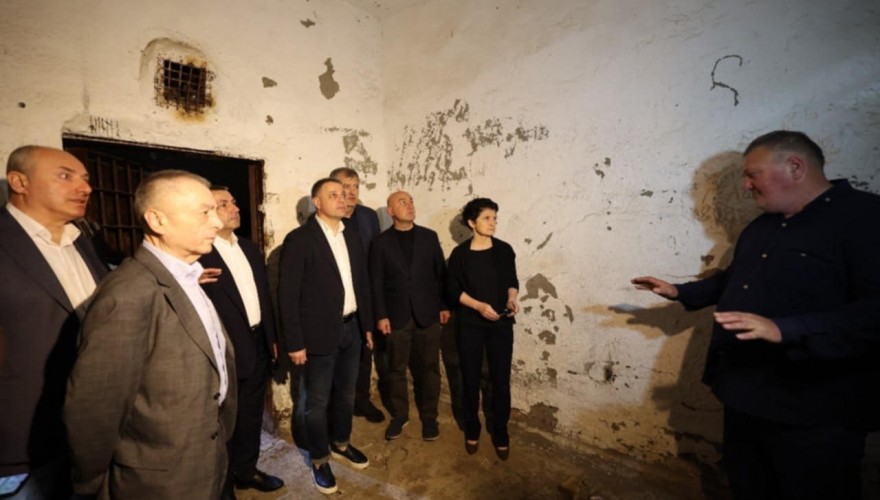
The Interim Fact-Finding Commission on the Activities of the Regime, the Political Leaders of the Regime of 2003-2012 and the Activity of the Incumbent and Former Officials in the Political Unions since 2003 up to today visited the quarantine areas, punishment cells and inmate housing in the former Penitentiary Department N13 of Khoni.
According to the Chair of the Commission, Tea Tsulukiani, the Khoni Penitentiary Department N13 is the symbol of Saakashvili’s government.
“At present, the Khoni Penitentiary Department is the sole remaining facility in Georgia where the so-called punishment cell of former President Mikheil Saakashvili remains undisturbed, preserved in its state in 2007-2009.
Given that the Commission had undertaken the investigation of the systemic crimes perpetrated within the penitentiary during the reporting period, it was understandably imperative to visit and assess the situation firsthand.
The cell walls bear the indelible marks of the prisoners’ struggles, with words etched into them, including the days and years counted by lines as they were isolated from the outside world.
The historical record, which has not yet been erased, will be included in our conclusion as photographic and video footage.
The Khoni Penitentiary Department serves as a symbol of Saakashvili’s government. Consequently, we reiterate that Saakashvili was not the architect of Georgia’s state but rather a torturer, who engaged in inhuman treatment and torture, resulting in the suffering of prisoners confined within these cells”, - she stated.
According to Sozar Subari, the Secretary of the Commission, the conditions in the Khoni Penitentiary Department were typical of other prisons.
“If we consider the overcrowding, where five, six, and potentially even ten prisoners were confined in cells designed for only two, we can comprehend the dire conditions faced by the inmates. When physical confinement in the cells became impossible, tents were subsequently installed in the yard, similar to the practice observed in Geguti, Rustavi, and particularly in Ksani. Nevertheless, the Khoni Penitentiary Department was still regarded as comparatively better in terms that the prisoners were subjected to milder forms of torture in comparison to the prevailing standards of other departments, and every prisoner harboured the aspiration of being incarcerated in Khoni”, - he remarked.
According to him, in line with the CoE standard, 4 m2 should be designated per inmate, which, naturally, was never adhered to by Saakashvili.
“If we also consider physical assault, torture, and lengthy prison sentences, including those of up to 15-20 years for minor crimes, we can comprehend the dire situation faced by the prisoners, whose numbers reached 24,5000, while the infrastructure was only capable of accommodating 10,000.
The former prisoners reported to the Commission that not only were the overcrowded cells unsanitary, but they also lacked mattresses, beds, and were forced to sit or lie on the concrete floor. This floor was often deliberately wetted, and the prisoners were subjected to this unpleasant and prolonged situation for weeks, compounded by the daily physical assault they endured. Even without the assault, this dire situation already constitutes torture, particularly since the physical assault resulted in various illnesses among the prisoners and continues to cause health problems. All of these factors contributed to the rise in prison deaths and the widespread prevalence of tuberculosis. The tuberculosis-positive prisoner was being incarcerated in cells with no air circulation, alongside other inmates, in an attempt to facilitate the spread of the disease. This deliberate practice was intended to break these individuals”, - he observed.
According to the Commission member, Ilia Injia, the Commission is getting cognizant of the dire reality that the prisoners sustained.
"We observed the dire conditions of the Khoni prison. Contrary to our expectations, the Khoni Penitentiary Department was perceived as a more suitable facility for confinement, and the prisoners expressed a desire to be transferred there.
Only this premise remains preserved among all the prisons. Everyone perceives the comparison between the past and the present, and everyone highlights all the newly constructed buildings and improved living conditions within the prisons”, - he asserted.