
Parliament Discussing Bill on Deoligarchization in I Reading
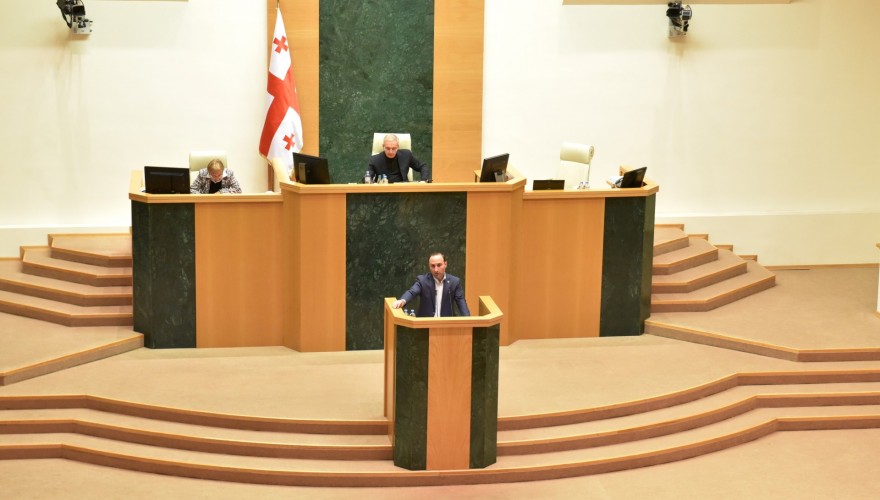
The Chair of the Legal Issues Committee, Anri Okhanashvili, introduced the Bill on Deoligarchization at the level of principles in I reading.
The document has been elaborated in compliance with EC’s 12 recommendations proposed for Georgia.
“The Working Group established at the Legal Issues Committee, which was composed of representatives of both – the parliamentary majority and the parliamentary opposition – has drafted the document through maximal transparency and engagement”, - A. Okhanashvili stated while expanding on the activities carried out within the Working Group.
As the rapporteur noted, the draft law is actually developed on the example of the Ukrainian law with similar content. It essentially repeats the norms of Ukrainian law, which has been approved by the EC.
"We transferred the statute based on absolutely objective parameters, as adopted by Ukraine, to the Georgian legislative space. If the European structures, towards which we strive, correctly evaluate the principles and adoption of the law on deoligarchization, then we have an expectation that it will deserve the same evaluation in relation to Georgia", - Anri Okhanashvili remarked.
The following matters are governed by the proposed law: The definition of the term "oligarch"; the issues of identifying someone as an oligarch and having them entered into the appropriate register; the issues of having someone removed from the register of oligarchs and the production of that register; the legal repercussions of doing so; the issues of certain people having to fill out declarations regarding their contact with the oligarch and their representative.
According to the document, an oligarch is a natural person who simultaneously satisfies at least three of the following conditions in order to have significant economic and political influence in public life: participates in political life; has a significant influence on mass media; represents an ultimate beneficiary of the entrepreneurial legal entity, which occupies a dominant position in the market and which maintains or exercises this position for 1 year; the confirmed amount of his assets and those of entrepreneurial legal entities where he is a beneficiary, as of January 1 of the relevant year, exceeds 1,000,000 times the subsistence minimum established for able-bodied persons.
The Parliament of Georgia makes a decision on recognition of a person with significant economic and political weight in public life (oligarch).
According to the bill, oligarchs will be included in a special register. The rules related to the register, including the rules for its creation and production, will be approved by the Parliament.
Anri Okhanashvili answered the questions of the lawmakers.
The representatives of the parliamentary opposition criticized the draft law and noted that this draft law cannot be adopted in this form.
"As for who they consider being oligarch in the EU and whose influence they talk about, because you haven't heard it yet, the assessments will be very harsh. Not because we don't want the country to receive the candidate status, but because your regime cannot comply with the requirements set by the European Union in order to grant candidate status to the country”, - Salome Samadashvili noted.
"I want to tell our fellow citizens that despite the tone of the argument inside or outside the legislature, we shouldn't let our hope about Georgia's future in Europe wane. This is your choice; we enshrined it in the constitution, and the European Union and the European Council formally acknowledged it when they awarded Georgia a European perspective. The nation is progressing and evolving in a European manner, and we must continue and complete our task", – the Vice-Speaker, Archil Talakvadze, noted.
According to Anri Okhanashvili, the parliamentary opposition actually offers the government not a systemically organized draft law, but an approach focused on individuals.
"The fact is that the radical groups do not and cannot forgive Bidzina Ivanishvili for the verdict that he passed on them together with the Georgian people in 2012. Together with our people, he defeated the authoritarian regime, which was manifested by the confessions from the representatives of these radical groups in the open space. They do not forgive him for his patriotism, everything he does to preserve and develop our cultural values, education, historical heritage”, - Anri Okhanashvili said in his closing speech.
The vote on the issue will be held at tomorrow’s Plenary Session.