
The Prime Minister of Georgia Was Heard in Parliament Under the Interpellation Procedure
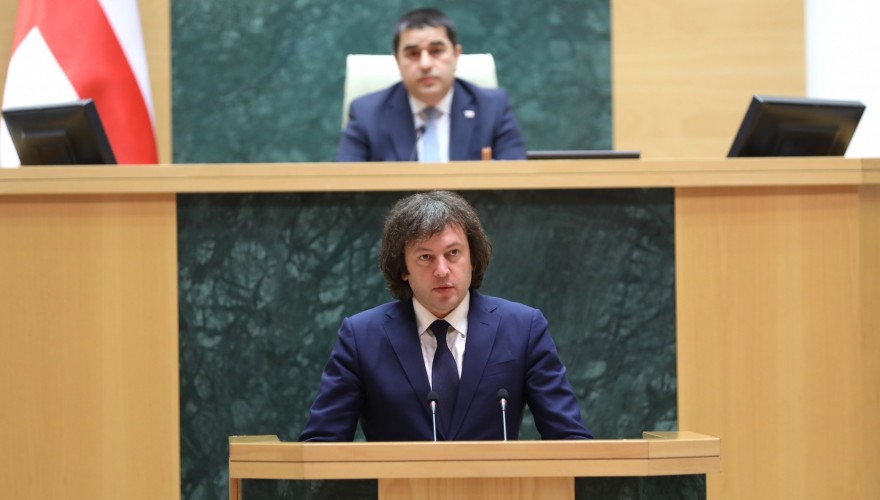
At the legislative body, the Prime Minister of Georgia, Irakli Kobakhidze, was heard under the interpellation procedure.
Questions prepared by the Georgian Dream faction addressed issues related to migration in Georgia, the residence of foreign nationals and the determination of their numbers, approaches toward irregular migrants, and the migratory impact of large-scale projects announced in the real estate sector. The questions were presented by the Chair of the faction, Irakli Kirtskhalia.
“Irregular migration is a challenge for the modern world. Therefore, the Government has a clear policy in this direction, as the effective fight against illegal migration is one of the key security issues. To properly manage this challenge, the legislative and executive branches work in coordination to maintain a clear distinction between illegal migration and foreign nationals legally residing in the country.
It is important for us that the public has accurate, fact-based information. For this purpose, the Georgian Dream faction addressed the Prime Minister under the interpellation procedure with questions related to migration, in order to ensure that the public is fully informed and that misinformation is not spread through political speculation”, - Irakli Kirtskhalia stated.
The Prime Minister began his address by presenting statistical data and noted that Georgia’s population stands at 3,914,000, of which a maximum of 257,000 are foreign nationals. He further stated that precise statistics on the residence of foreign citizens in Georgia will be published on 25 June, and it is expected that the figures will decrease further.
“Immigration to Georgia is driven by several important factors. First, Georgia is a tourist country, and under such conditions, managing migration processes is complex. As you know, the education system is open to foreigners, and currently, 37,000 foreign students are studying in Georgia. The third important factor is labor migration. There is a significant shortage of workforce in many sectors in Georgia, and without foreign labor, numerous projects would have been suspended due to the lack of Georgian workers available for employment in relevant fields”, - Irakli Kobakhidze stated.
The Prime Minister spoke about various types of residence permits in Georgia and noted that 107,307 citizens from 164 countries currently hold residence permits.
“As for the statistics, 32,129 residence permit holders are citizens of the Russian Federation. I would like to clarify that a large portion of them are former Georgian citizens and persons bearing Georgian surnames. According to border-crossing statistics, approximately 30% of Russian citizens residing in Georgia as foreigners are, in fact, ethnic Georgians.
India ranks second, with 23,930 residence permits issued, the vast majority of whom are students studying in Georgia.
Azerbaijan ranks third with 6.3%, and it may be assumed that the majority are ethnic Azerbaijanis who previously left Georgia, acquired Azerbaijani citizenship, and later returned.
As for Ukraine, 6,290 individuals hold residence permits; however, in addition, pursuant to our legal acts, up to 25,000 Ukrainians reside in Georgia under refugee status without residence permits. In total, the number of Ukrainians in Georgia is approximately 30,000.
More than 5,000 citizens of Armenia hold residence permits. We assume these individuals previously left Georgia, acquired Armenian citizenship, and subsequently returned.
Residence permits have also been granted to 3,738 citizens of Belarus, 3,645 citizens of Turkey, and 3,331 citizens of Iran. Citizens of Sudan, Jordan, Pakistan, and Egypt residing in Georgia with residence rights are primarily medical and other university students. As for more than 2,000 citizens of China, they are mainly employed in infrastructure projects”, - Irakli Kobakhidze stated.
The Prime Minister also presented statistical data on residence permits and discussed the conditions for issuing study, permanent, labor, short-term, and special residence permits, explaining the grounds upon which such permits are granted.
Addressing the issue of irregular migration, Irakli Kobakhidze stated that approximately 20,000 irregular migrants currently reside in Georgia and that the Migration Department of the Interior Ministry is implementing appropriate measures to facilitate their removal from the country.
“Over the past 12 months, we have expelled more irregular foreign nationals than in the previous ten years combined. According to our plan, efforts to combat illegal migration will be further intensified, and during 2026, we expect to manage the expulsion of approximately 20% of irregular foreign migrants”, - the Prime Minister stated.
He further noted that under the new legislation, fines have been increased to between GEL 1,000 and GEL 3,000, and, in addition to monetary penalties, entry bans have been imposed on foreign nationals who commit relevant violations.
“Depending on the nature of the offense, an entry ban ranging from six months to three years is envisaged as a measure of responsibility. Since 1 October of last year, such a ban has been imposed on 2,331 individuals. Additionally, in cases of criminal offenses, separate liability has been established, including expulsion and an entry ban ranging from two to twenty years, depending on the category of the offense. Since 1 October, this measure has been applied to 52 individuals as a form of punishment”, - Irakli Kobakhidze stated.
Following the Prime Minister’s address, the interpellation continued in a question-and-answer format.
Irakli Kobakhidze responded to questions from Members of Parliament and provided additional clarifications on the matter.