
Address by the Speaker of the Parliament of Georgia, H.E. Shalva Papuashvili, on the Annual Report of Parliamentary Activities and the Action Plan for the Coming Year
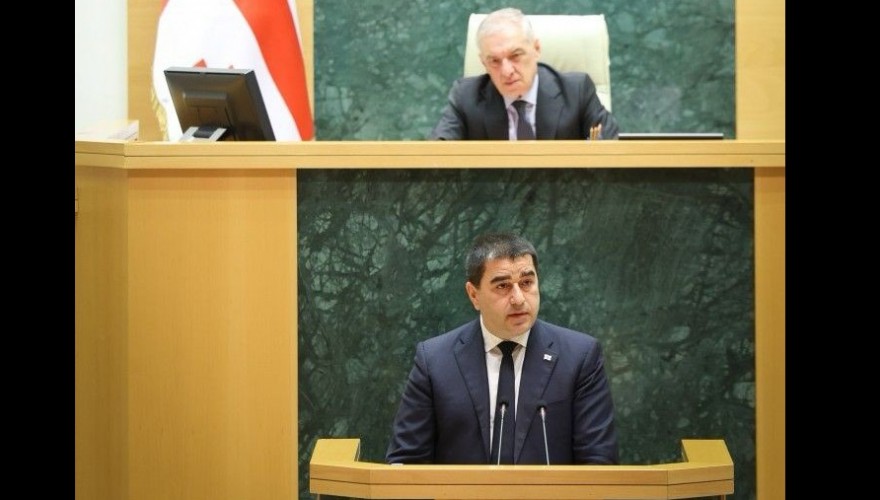
Ladies and gentlemen, dear guests,
You all have in front of you a copy of the 2024 Report on the Performance of the Parliament of Georgia allowing both, you and the public to familiarize yourselves with the legislative or oversight activities carried out, in both narrative and statistical terms.
Today, however, I would like to report to you on the work of the 10th Convocation of the Parliament in its entirety, not just for the last year, with emphasis on the political factors and turbulences we have all had to tackle together.
Indeed, the 10th Convocation of the Parliament has become a turning point in Georgia’s contemporary history in that it has been a solid and courageous assembly for strengthening sovereignty and protecting national interests. Each member of this assembly, both acting and former, should be proud of their contribution to Georgia’s protection and progress.
The past four years of the 10th Convocation of the Parliament have been full of obstacles, foreign influences, and interference in domestic affairs, destructive groups shaking the foundations of the state, interest groups opening up a political front, betrayal, subversions, and snares set by friend or foe. Yet it was this difficult time that brought to the fore the loyalty, wisdom, and trust of the Georgian people to the fullest, the reason why this period has become a turning point.
Even there was a recurring theme in the work of the Parliament’s previous convocation, it must have been a cascade of attempts to reverse the country’s development, cause chaos, and start a revolution, in this way intending to harm our society. As a result, however, our society has emerged more seasoned, self-confident, and wiser.
To understand how we have succeeded, we must call to mind what we have been through together with our society.
Revolution, attempt 1: “Parties’ Revolution”
It all started during the pre-election campaign of 2020, when Georgian Dream received open, straightforward indications that it had to cede power in defiance of the upcoming elections’ results and the will of the people. You remember the campaign emphasizing the termination of two parliamentary terms, democracy lessons delivered by foreign ambassadors on the benefits of coalition government, and other similar indications.
Georgian Dream claimed a sweeping victory in the October 31, 2020 elections that were - in keeping with tradition - labeled as stolen by the opposition consolidated around the National Movement. We saw a weeks-long campaign, demonstrations, and protest in front of the Central Election Commission drawing on quick count results forged by NGO “Fair Elections” (ISFED). The 10th Parliament convened on December 11, 2020 and announced the subsequent establishment of an investigation commission to probe into forged quick count results, among others. On the same day, Fair Elections (ISFED), fearing parliamentary investigation, publicly admitted fraud. Later on, we heard another admission revealing that the United States Agency for International Development (USAID), donor of Free Elections, was also implicated in the dissemination of fraudulent results, marking the first time when Georgian society exposed what the new US Administration would unveil four years later, namely that USAID was used to destabilize the government and replace popular democracy with one run from the outside.
While the political team of the newly elected Parliament was busy fully debunking the myth of stole elections, in February 2021, we witnessed a spectacle featuring Giorgi Gakharia, who categorically demanded that Nika Melia’s parliamentary immunity be revoked on one day, while the next day - as he was supposed to come through with this decision as promised - took one selfie and took off, a move designed to add fuel to the fire of the radicals camped in their imaginary stronghold. An answer to this seemingly inexplicable step became known to the public fairly recently, during an interrogation conducted by the investigative commission, when Gakharia, after a few attempted lies, was forced to admit that this act of betrayal against the state, voters, and the political team - one supposed to cause the government to collapse - was coordinated with one of the ambassadors.
Fortunately, his and his advisor’s calculation once again proved wrong. However, it became clear that pressure would assume increasingly dangerous forms, the reason why, in spring 2021, Georgian Dream agreed to participate in a political process mediated by Charles Michel which ended with an agreement with a small group of parties.
Incidentally, the process of working on what would become known as the April 19 Agreement revealed one noteworthy factor. It turned out that our European and American friends, serving as mediators, had a different understanding of their mandates, and their objectives sought much more than just mediating between two sides. New provisions kept appearing in the agreement’s text: for example, a requirement to ensure a qualified majority to elect prosecutor general, something that numerous parties and NGOs demanded at the time. As I read this provision in the agreement, I asked the mediators about the source of this matter. Silence was their response. Later, I questioned opposition parties and NGOs on this issue. Everyone denied involvement. That was the first indicator showing that those posing as mediators were in reality political actors pushing their own agenda. This episode is a well-documented case of foreign influence and interests, and I am a witness and participant of it.
Revolution, attempt 2: Media Workers’ Revolution
Despite the agreement, the radical opposition’s core refused to sign the document and enter the Parliament, in this way continuing the process of political polarization, and attempt to escalate the crisis that was supposed to be put to work during the municipal elections. This is why, by the end of July 2021, Georgian Dream got out of the April 19 Agreement and launched an election campaign.
The division among the public was once again used in the period between April and August, this time playing the minority rights’ card, and holding LGBT marches that, subsequently, degenerated into violent processes, while media workers, turning into political activists, emerged on the central scene on Rustaveli Avenue. The failed Parties’ Revolution in 2020 was replaced with the roar of media workers in 2021.
Although the agreement mediated by Charles Michel was terminated, the 43% threshold to be passed by Georgian Dream in the 2021 elections still stood for a symbolic benchmark. We all remember how the National Movement was made sign the already terminated agreement, i.e. only on paper, just to enable the then EU ambassador, settled pompously in an armchair, to address the public in a video, informing that the agreement was now in full force, in this way hanging the threshold like the sword of Damocles.
Revolution, attempt 3: Sour Cream Revolution
Every objective study showed that Georgian Dream had no problem with popular legitimation and support, also convincingly winning the local elections. And a new revolutionary plan was quick to unfold. The Georgian state suffered a blow devised and carried out by foreign special services and their collaborators at home. Two days prior to the elections, Ukraine’s military intelligence service used a sour cream container to smuggle Mikheil Saakashvili into the country, also preparing for him a scenario for starting revolutionary processes immediately after the publication of the election results. For the purpose of chronology, we must add that Saakashvili, two days before sneaking into the country, was prancing through Brussels’s halls and holding meetings.
This revolutionary attempt failed too. The state security structures detained Saakashvili on the eve of the elections. The Moor failed to do his job, though still the Moor proved useful. After losing the elections, the opposition started another wave of hysterics around Saakashvili’s supposedly imminent but in reality imaginary death because of hunger strike. Letters were written, rallies were held, foreign ambassadors holding fake demarches and asking fatalistically “What if he really dies?” in an attempt to blackmail the government, Saakashvili’s curator MPs from the Baltic states holding debates, adopting resolutions, and bending over backward to apply illegal pressure on our authorities in order to save Saakashvili from lawful punishment and get away with a planned revolution. Yet this attempt also proved futile. Saakashvili has miraculously beat dementia diagnosed by his doctors, who trampled down the Hippocratic Oath, and now quietly continues serving his time.
Yet why was Saakashvili’s figure so important? Why was it necessary to change the government through him? What role were supposed to play in a broader regional picture the protest and revolution starting during the local elections? Was it a desperate revanchist attempt by the National Movement or something bigger?
Answers to these questions became clear three months after Saakashvili’s failed revolution. On February 24, 2022, the biggest and bloodiest war since WW II broke out in Europe. The Russian Federation invaded Ukraine. International relations, security systems, defense architecture, and pretty much everything changed overnight. The West and Russia found themselves in a long-term war.
Georgia’s population and we knew well what this war meant to Georgia. The scope of this war would easily reach us, and Russian tanks would once again roll down the familiar tracks. The magnitude of risks, cautious policy, and national interests above all once again turned Georgian Dream into a target for the opponents.
In the earliest days of Russia’s aggression, Georgian authorities stated their clear position, declaring solidarity with Ukraine, engaging in humanitarian aid provision, the Ramstein format, calling off the remaining diplomatic mission in Kiev, condemning the war, and taking the side of peace.
In the same vein, a fire of destruction and subversions was opened in the earliest days. We received another protest wave from the radical opposition demanding that we send volunteers to Ukraine, impose sanctions on Russia, close the sky, enforce visas, and - in a nutshell - sign up for a total and unconditional escalation.
We opposed this jointly developed and thought-through action plan toward which we were urged in one voice by our ever-vigilant “well-wishers” using various channels. In closed meetings, all these messages were far more direct, open, and unambiguous. We were told about it by diplomats and visiting emissaries, parties run from the outside, and NGOs pursuing foreign interests: “We must use this window of opportunity,” “Let’s fight if we have to,” “Join the right side of history,” “A fire of bombs is better than burning with shame,” “So what if a war starts? If anything, Russia cannot fully control you.” Messengers changed, but the key message remained, as though taken from the same textbook - a second front had to open in Georgia.
These messages sound unbelievable today, right? Our opponents did not believe either when the prime minister of Georgia and Georgian Dream’s honorary chairman told identical stories of pressure on the Georgian government, right?
These calls were directly aimed at the unfolding of events in Georgia in a way that would ultimately result in military adventurism, and the opening of a second front here. However, it did not work in Georgia, so this plan was labeled as made-up. Yes, but did not a second front actually open in the Russia-Ukraine war?
Let’s remember the Kursk operation, when Ukraine took over a part of the Russian Federation’s territory, precisely with the goal of Russia deploying its forces away from the front, in this way mitigating military pressure. Let’s have a look at the scope of this operation: 15,000 soldiers from the Ukrainian side and 60,000 from Russia’s side, and let’s remember similar data from the 2008 war. Perfect match.
And a copy of this Kursk was supposed to take place in Georgia, a much better battlefield for achieving political goals. Another victimized state, more mourning women and crying children, additional pressure on countries undecided about military assistance.
Now let’s think, what would have happened if the Sour Cream Revolution plan worked, and this war were met by so-called honest citizens in power, those who, in parallel to the war in Ukraine, stood on Rustaveli Avenue wrapped in Ukrainian flags, demanding soldiers be sent, the sky be closed, and sanctions be imposed? They would enter a spiral of escalation ultimately guaranteeing a war, would not they? Another Kursk would happen here, right? A second front would open up here, right?
And we averted this very scenario from our country, and it was the 10th Convocation of the Parliament that stood in the vanguard of measures toward political defense.
Revolution, attempt 4: NGOs’ Revolution
On February 28, 2022, Ukraine, still responding to the initial strikes, applied for the EU membership. Given the then circumstances, Moldova and Georgia followed suit. On June 23, the European Commission granted the candidate status to Ukraine and Moldova, while denying the same status to Georgia, a country ahead - both at the time and now - of both Moldova and Ukraine in every way. The only result brought about by this politically motivated decision lay in encouraging the radical movement in defiance of national interests, and for the benefit of the warfare agenda.
After the failed revolutions of political parties and media outlets, the Rustaveli central stage was taken over by NGOs, and another revolutionary scenario was set in motion. Forces that came to the fore were included in the demands for the EU candidate status as ones to be engaged in decision-making at every governmental level, with everything to be done with their participation and based on their evaluations. Emboldened by this encouragement, they would not hesitate to demand from the Parliament to abolish the government, and to put together a new government with participation of NGOs with the right to veto. Of course, NGOs - who, traditionally, think only of their donor’s benevolence and are totally detached from people - failed to match public sentiments, so this revolutionary attempt was botched, too.
However, placing foreign-funded organizations on the scene of battle for power proved too much even for a country open to donors like ours. In numerous meetings, both at home and abroad, we stated that spending money in another country is more than just accountancy, and that donors must feel responsible for the actions of NGOs financed by them. And the easiest way to ensure that lay in the transparency of financing and accountability to the Georgian people. Our words, however, fell to deaf ears. Donors were focused on their own plans, and the concerns of the Georgian people seemed secondary to them.
Revolution, attempt 5: Donors’ Revolution
With donors dodging the responsibility for the outcomes of their spending, the only thing remaining was to regulate this matter on a legislative level. In the spring of 2023, the Parliament launched a legislative process designed to ensure the publicity of the shadow financing in Georgian politics. No country is allowed to spend millions of dollars to influence the life of another society, and hold back from this society how much and to what purpose it spends. Such patronizing attitude toward other countries, and thinking in terms of “third world countries” and “banana republics” is dead and buried in the 20th century.
The Law on Transparency and the events unfolding around it served as a litmus test. The torch of the 2023 revolutionary movement was passed directly to foreign politicians and donors who took the front seat. This is exactly why one of the ambassadors first labeled the Law on Transparency as Russian, and this is exactly why a man trying to burn another person with a Molotov cocktail was hailed as a hero, and this is exactly why hurling stones was considered as peace, and arresting stone-hurlers as war. However, just as Molotov cocktails, putting foreign curators in charge of the country’s fate is alien and unacceptable to our society. We slowed down the process, the reason why this revolutionary attempt also fell through. In 2023, every foreign or domestic actor who would impact Georgia’s parliamentary elections was identified and exposed.
Consequently, in 2024, we went through the election campaign period with unprecedented foreign interference. We were told that it was the final battle, all against one. That it would be a referendum.
The collective UNM, larger or smaller NGOs, activist media workers, destructive partisan TV channels, well-trained demonstrators, foreign donors and diplomats, they all rose up for the elections christened as a referendum, led by yesterday’s president past expiration date.
The agenda of going halfway, one matching foreign interests and camouflaged as European prospects, stood opposite of a genuine agenda building on Georgian, national interests, one of peace and prosperity, one embodied by Georgian Dream.
Fortunately, the Georgian nation - with its knowledge of history’s lessons and deep civilizational memory - with an absolute majority of voters, has clearly discerned where the truth, truthfulness, and the country’s genuine interests lie - discerning and making the right choice.
Strength is in unity, and kindness makes whole, while evil divides. Historically, this has been the formula of Georgia’s defeat, our dissension and disunity. This time too, this polarization has been pushed on us by foreign forces, and their CANVAS- or USAID-style propaganda, hatred, and legalized violence are nothing short of being identified with the EU, and some politicians and diplomats from EU member states have direct shares in this tragic equation. Now we face a paradox: violence walks the streets wrapped in an EU flag.
Under these circumstances, the formula of victory lies in unity, strength, and faith in your country, your people, your history. And we have won this decisive battle.
The 10th Convocation of the Parliament became a turning point, when we picked national interests as the cornerstone of the country’s development, while being guided by wisdom in political decision-making. And the wisdom lies in locking the stable door before the horse is stolen. And this is what we have accomplished. We have kept the horse safe, and prevented the country’s history from being reversed.
Today, this mission has been taken over by the 11th convocation of the Parliament. Today, we are continuing this cause, further serving our country’s interests. The country’s reunification and the prosperity of our every citizen make up our two most important objectives - every other goal, intention, and aspiration is defined by these two.
May God protect us in this cause!