The Prime Minister reported on higher education reform to the Parliament within the interpellation
Plenary 26 Nov 2025
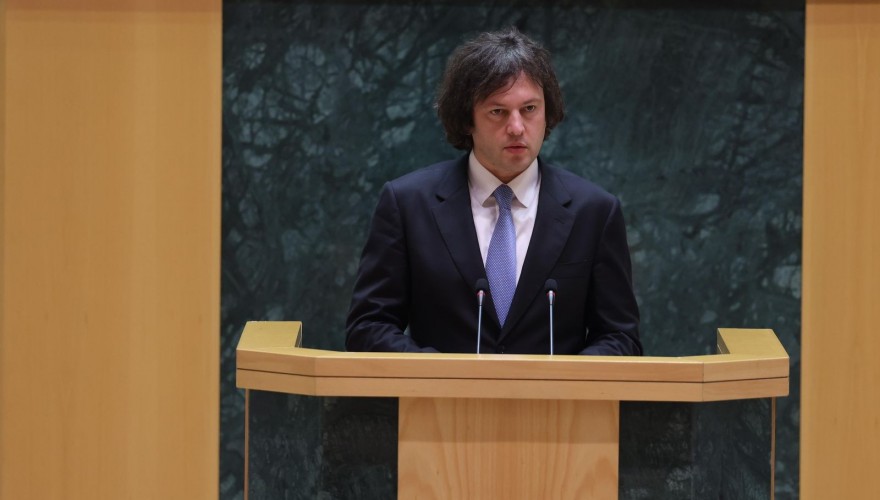
The Prime Minister, Irakli Kobakhidze provided the report to the Parliament within the interpellation procedure regarding the higher education reform. The questions to the Prime Minister were addressed by the Faction “Georgian Dream”.
“We are currently facing a difficult and unfavorable situation in the education system; the overall level is unsatisfactory. Therefore, we need to implement comprehensive changes in order to establish a European-standard education system in our country. Achieving qualitative convergence, even within a four-year period, is realistic. This includes the quality of teaching, infrastructure, academic programs, textbooks, and personnel policy. This constitutes the main goal and objective of the education reform,” - stated Irakli Kobakhidze while assessing the current state of the education system.
While speaking about the need to reform higher education, the Prime Minister outlined seven conceptual approaches and explained the significance of each.
“One of the major challenges is the non-optimal use of resources and unequal quality across universities. To ensure the most efficient use of both infrastructure and human resources, a specific principle must be introduced into the higher education system: one city, one faculty. In Tbilisi, within one city, each faculty should exist only once in state universities. This does not apply to private universities. For example, the Faculty of Law currently operates in four different universities in Tbilisi. In one case, the level is average; in another, below average; in the third, lower than below average; and in the fourth, even lower. This is today’s reality. Optimization will enable us, in the medium term, to ensure that the Faculty of Law in Tbilisi provides essentially the same quality and standard of education as in developed countries”, - the Prime Minister noted.
Irakli Kobakhidze also discussed the student grant-funding model and emphasized that the approach established years ago now requires revision and renewal.
“It is important to assess which fields have which specific needs, and define particular specialties accordingly. For example, training a medical doctor may require more funding than training a lawyer. The current model does not even take this into account. All of this must be reviewed. We believe the existing grant model should be replaced with a demand-based system that will consider multiple components collectively”, - stated Irakli Kobakhidze.
The Prime Minister also spoke about a new model of student learning in higher education institutions.
“No one has thoroughly analyzed how necessary the 4+2 system truly is. We conducted an in-depth analysis and concluded that transitioning to a 3+1+1 system is well-founded. It is entirely possible to complete a high-quality bachelor’s program in three years, a master’s program in one year, and—if the student wishes to continue academic activity—one additional year. Such a system already operates in many developed countries. Therefore, this system is compatible with the Bologna Process and, at the same time, ensures improvement of the overall system. It will also lead to cost savings—expenses will be reduced by approximately 25%, allowing us to invest more directly in enhancing the quality of education”, - noted Irakli Kobakhidze.
According to the Prime Minister, university personnel policy and the lack of modern-standard academic programs and textbooks also represent significant challenges.
He stated that it is essential for higher education institutions to train specialists based on labor-market demands so that students acquire skills in professions that are scarce and highly sought after.
“There is a shortage in virtually every field. One of the main issues lies in technical professions—construction specialists, architects, engineers, and geologists. We face serious challenges, including in terms of quality, because we lack qualified personnel in many areas. Consequently, if the higher education reform is not implemented, we will remain exactly where we are today”, - stated Irakli Kobakhidze.
The Prime Minister concluded his remarks on higher education reform and its related challenges by addressing the infrastructural condition of state universities.
According to him, it is crucial to address the current infrastructural needs, including student dormitories as well as facilities intended for cultural and sports events.
The Prime Minister responded to questions from members of parliamentary factions and political groups, providing additional explanations.