Shalva Papuashvili: I represent the government that has done the most to advance Georgia towards the EU - Georgia remains strongly committed to the European Union membership path
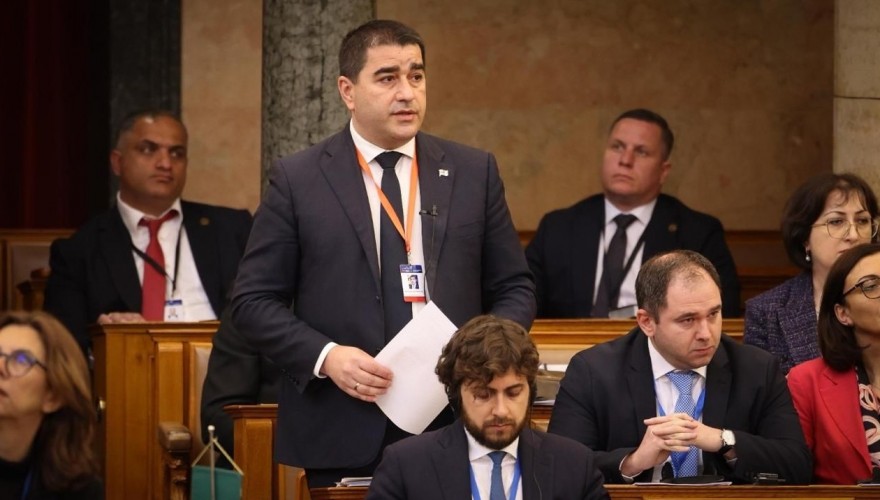
“Today, as Europe faces serious challenges, the debate about federalism and national sovereignty should center on maximizing the benefits of integration while respecting the autonomy and traditions of member states”, - Shalva Papuashvili, Speaker of the Georgian Parliament, stated in his address at the Conference of Speakers of the European Union Parliaments in Budapest, Hungary.
As the Speaker highlighted, regrettably, we see a tendency by some European institutions to speak with us in a language of directives. According to him, Georgia remains strongly committed to the European Union membership path.
“Excessively empowered central structures of the European Union might not allow for making decisions that best reflect unique political, economic, and cultural contexts of each country.
Georgia remains strongly committed to the European Union membership path. I represent the government that has done the most to advance Georgia towards the EU. From the Parliament’s point of view, we have seen some peculiar treatment from the European institutions. While the Parliament is elected by the Georgian people and represents its will, regrettably, we see a tendency by some European institutions to speak with us in a language of directives, imposing obligations without granting the rights. Having obligations without the right of the voice, especially within the EU institutions where Georgia has no representation as yet, does not fit well with the very principle of democratic pluralism, on which the EU rests.
The centralized EU structure sometimes imposes strict conditionality that does not necessarily reflect the consensus. One example of this practice was the demand from Georgia to establish a system of extraordinary integrity checks for judges, so-called ‘vetting’, conducted by foreign actors. This system, if accepted, would contradict the very principle of democracy, where authority stems from the people. The entire branch of power would thus become set up by the foreign actors, which goes contrary to the very essence of national sovereignty. I doubt that any of the EU member states would have allowed such an intervention in their sovereignty”, - the Speaker underlined.
According to him, in a community of nation-states, small states’ voice should be heard equal to the others, because the truth is not measured by the quantity alone.
“Democracy shall be based on deliberation, not imposition. Consensus ensures that decisions are made collaboratively, respecting the interests and concerns of all member states and partners. This, also, means a Europe where decisions are made not only in centralized unelected bodies, but increasingly closer to the people. In this regard, it is worth giving a more critical examination to the current debate about replacing consensus-based decision-making with a majority principle. In a community of nation-states, small states’ voice should be heard equal to the others, because the truth is not measured by the quantity alone”, - he stated.