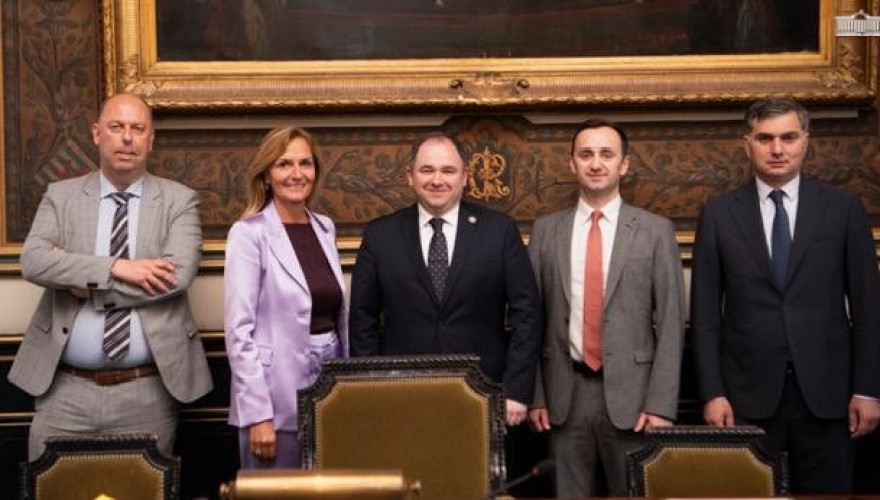
Environmental Protection and Natural Resources Committee Introducing White Paper on Climate Change for Public Consultations
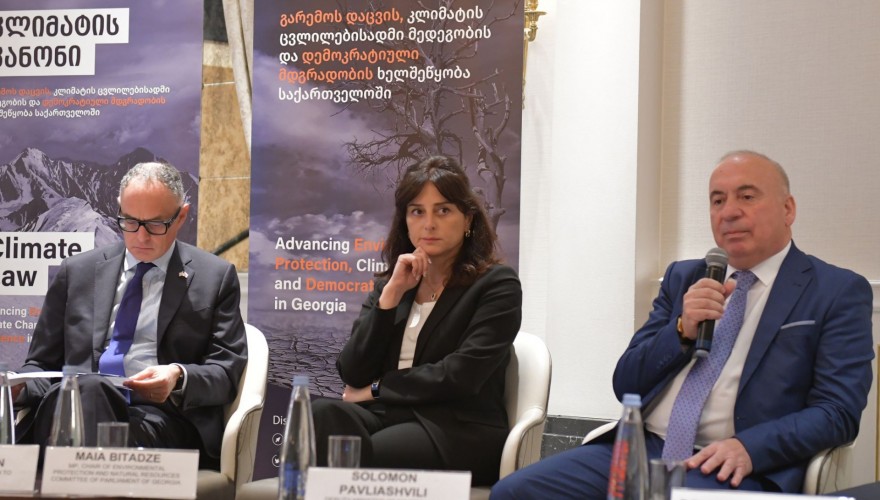
The White Paper on the Climate Change Law of Georgia has been released for public consultation at the initiative of the Environmental Protection and Natural Resources Committee, with support from the Ministry of Environment and Agriculture, the UK Government, and the Westminster Democracy Foundation.
The Chair of the Environmental Protection and Natural Resources Committee, Maia Bitadze, highlighted that while Georgia has taken significant steps to address climate change consequences and fulfill international commitments, the country lacks a comprehensive legal framework to regulate critical climate-related issues. Consequently, the Committee has initiated the development of a climate change law, aimed at consolidating fragmented climate legislation into a unified framework. Bitadze emphasized that this draft law is being developed using an innovative approach.
M. Bitadze mentioned that earlier this year, the Committee published a Green Paper on Climate Change as a consultation document, seeking input from various societal groups. Additionally, extensive consultation meetings were held in Telavi, Kutaisi, and Tbilisi. The White Paper has been created by analyzing and reconciling the feedback obtained during these public consultations, taking into account suggestions from civil society.
The White Paper contains legislative proposals on key climate-related issues and outlines the principles that should underpin the development of climate change law. Before the final draft law is formulated, public discussions on the White Paper will be conducted to ensure consensus on the principles to be incorporated into the climate change law.
"The development of this new legislation on climate change is a significant step towards aligning Georgia with international environmental and climate change laws and standards. Following the presentation of the White Paper, the next phase will involve public consultations, with both the Environmental Protection and Natural Resources Committee and the Ministry actively participating in the process. Simultaneously, work on drafting the bill itself has begun in collaboration with experts. It is expected that the draft law will be completed in the spring of the next year and will provide a comprehensive legal framework for addressing the critical challenges posed by climate change, which has already had adverse impacts on Georgia”, - Maia Bitadze stated.
According to her, in general, this year was particularly painful due to climate change, not only for our region, but for the whole world, the anomalous processes that are taking place in this regard continue to this day, and therefore joint efforts are needed to minimize the painful consequences of climate change.
"I believe that the process will be highly successful, and ultimately, we will establish a legal framework that will facilitate our adaptation to climate change. This legal foundation will enable us to more effectively address the challenges posed by climate change in the coming decades”, - the Chair of the Committee stated.
The Chair of the Environmental Protection and Natural Resources Committee expressed her gratitude to the UK government and the Westminster Democracy Fund for their continuous support to Georgia. The event's participants also received information on how the national consultation process for the White Paper will be conducted, including the upcoming public hearing led by the Center for Environmental Information and Education. Solomon Pavliashvili, Deputy Minister of Environment Protection and Agriculture of Georgia, Mark Clayton, Ambassador Extraordinary and Plenipotentiary of Great Britain to Georgia, and Lasha Nakashidze, Head of Representation of the Westminster Democracy Foundation in Georgia, also participated in the presentation of the White Paper on Climate Change Law of Georgia and addressed the audience.
Representatives from legislative and executive authorities, various non-governmental organizations, the civil sector, and business associations attended the event.
The document was prepared with the financial support of the United Kingdom government under the Westminster Foundation for Democracy (WFD) program "Environmental Protection, Climate Change Resilience, and Democratic Sustainability Promotion in Georgia".